

- AI tools are pervasive and can significantly accelerate software development, provided they are used thoughtfully.
- The community is quickly growing disillusioned with “AI slop” and sloppily-built projects, causing a backlash against AI-generated code.
numpy-ts was built with the assistance of AI tools (e.g., Claude Code). The contribution graph below tells the story clearly:
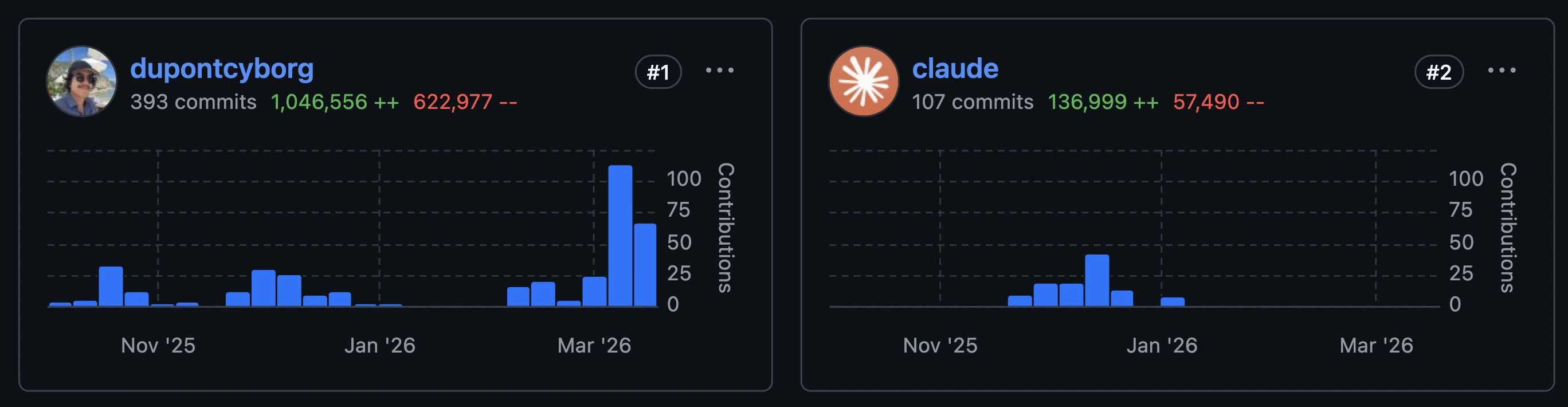
I have used LLMs since January, just not as actively. Some hugely manual changes (e.g., changing dtype promotion rules) were implemented by AI simply due to the sheer volume of minor code changes. It was all, nonetheless, validated by me and reviewed line-by-line.
- Boilerplate code generation
- Implementing well-specified algorithms (e.g.,
np.dot,np.sum, etc.) - Writing test scaffolding and generating test cases
- Building and maintaining benchmarks
- Drafting documentation and usage examples
- Architecting complex systems (e.g., the WASM acceleration layer)
- Performance optimization and low-level code decisions
- Debugging and correctness assurance, especially for edge cases
- Every line of code is human-reviewed. AI-generated code was never merged without review by me (@dupontcyborg), a full-time software engineer with >10 YOE.
- AI was a productivity tool, not an author. The same way a project might use code generation, linters, or scaffolding tools, AI accelerated the tedious parts so more time could be spent on the hard problems.
- I make mistakes, and lots of them. Nothing more to add here :)