In 2026, I see two competing narratives around AI in software development:
  1. AI tools are pervasive and can significantly accelerate software development, provided they are used thoughtfully.
  2. The community is quickly growing disillusioned with “AI slop” and sloppily-built projects, causing a backlash against AI-generated code.
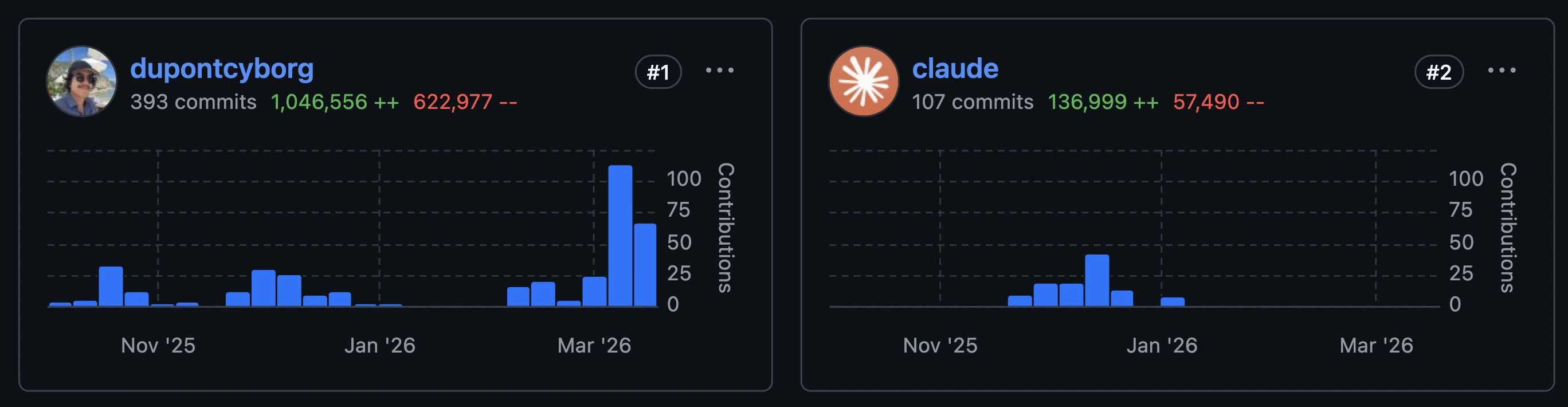
To navigate this landscape, I believe in radical transparency about how AI is used across projects, including this one. numpy-ts was built with the assistance of AI tools (e.g., Claude Code). The contribution graph below tells the story clearly: GitHub contribution graph showing dupontcyborg (393 commits, 1M+ lines) and claude (107 commits, 137K lines) Claude was used primarily during the prototype and early implementation phase (Nov 2025 - Jan 2026) to accelerate the initial buildout of numpy-ts’s 450+ API functions. This included generating first-pass implementations of well-specified NumPy functions, test scaffolding, and documentation. Architecture, optimization, and WASM acceleration work was done manually (Jan 2026 onward). This work requires systems expertise and cannot be meaningfully delegated to AI. The WASM microkernels, memory management strategy, and tree-shaking architecture were all designed, and mostly implemented, by hand. In my experience building numpy-ts, AI tools excelled at:
  • Boilerplate code generation
  • Implementing well-specified algorithms (e.g., np.dot, np.sum, etc.)
  • Writing test scaffolding and generating test cases
  • Building and maintaining benchmarks
  • Drafting documentation and usage examples
On the other hand, it was pretty bad at:
  • Architecting complex systems (e.g., the WASM acceleration layer)
  • Performance optimization and low-level code decisions
  • Debugging and correctness assurance, especially for edge cases
Trust is built on transparency. It’s no different for open-source projects. So you should know that in this project:
  1. Every line of code is human-reviewed. AI-generated code was never merged without review by me (@dupontcyborg), a full-time software engineer with >10 YOE.
  2. AI was a productivity tool, not an author. The same way a project might use code generation, linters, or scaffolding tools, AI accelerated the tedious parts so more time could be spent on the hard problems.
  3. I make mistakes, and lots of them. Nothing more to add here :)
I’m just as tired of the AI-slop as everyone else. But it’s not binary: it’s not “AI-generated = bad” and “human-generated = good”. Nuance is hard but important. I hope this disclosure helps to make that nuance a little easier.