> ## Documentation Index
> Fetch the complete documentation index at: https://numpyts.dev/llms.txt
> Use this file to discover all available pages before exploring further.
# Performance Overview
numpy-ts is **1.13x faster** than NumPy on average across 7,159 benchmarks (small, medium, and large arrays) and runs natively in JavaScript + WASM with zero dependencies. It's faster in **12 of 18 categories**, with standout wins in gradient computation (4.3x), polynomial operations (3.2x), and boolean logic (2.3x).
All benchmarks compare computation time between JS (numpy-ts) and Python (NumPy with OpenBLAS), measured on each side respectively. See [methodology](./methodology) for details.
## Performance by Category
numpy-ts outperforms NumPy in most categories. NumPy leads in bitwise, trig, and math — all active areas of improvement.
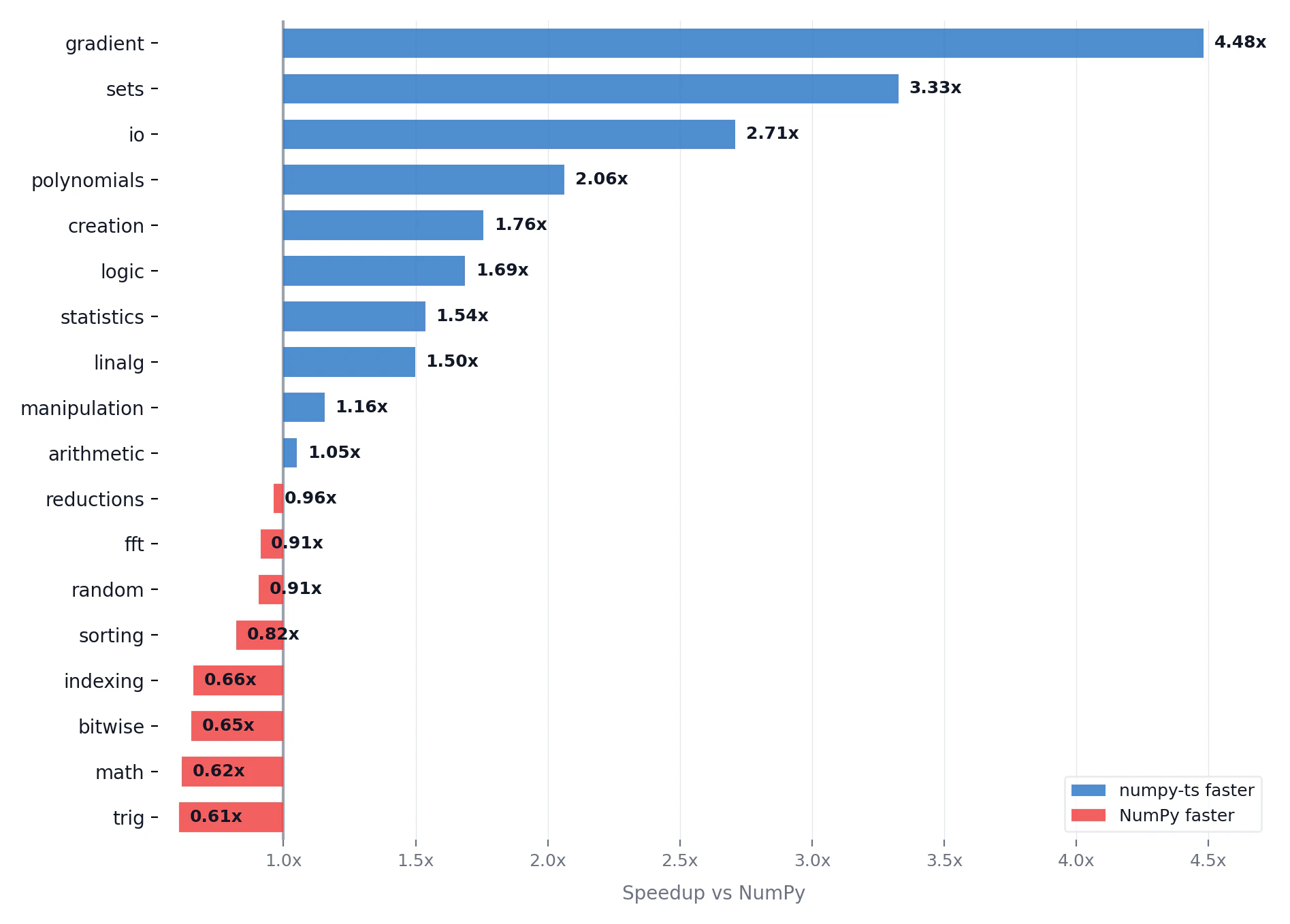
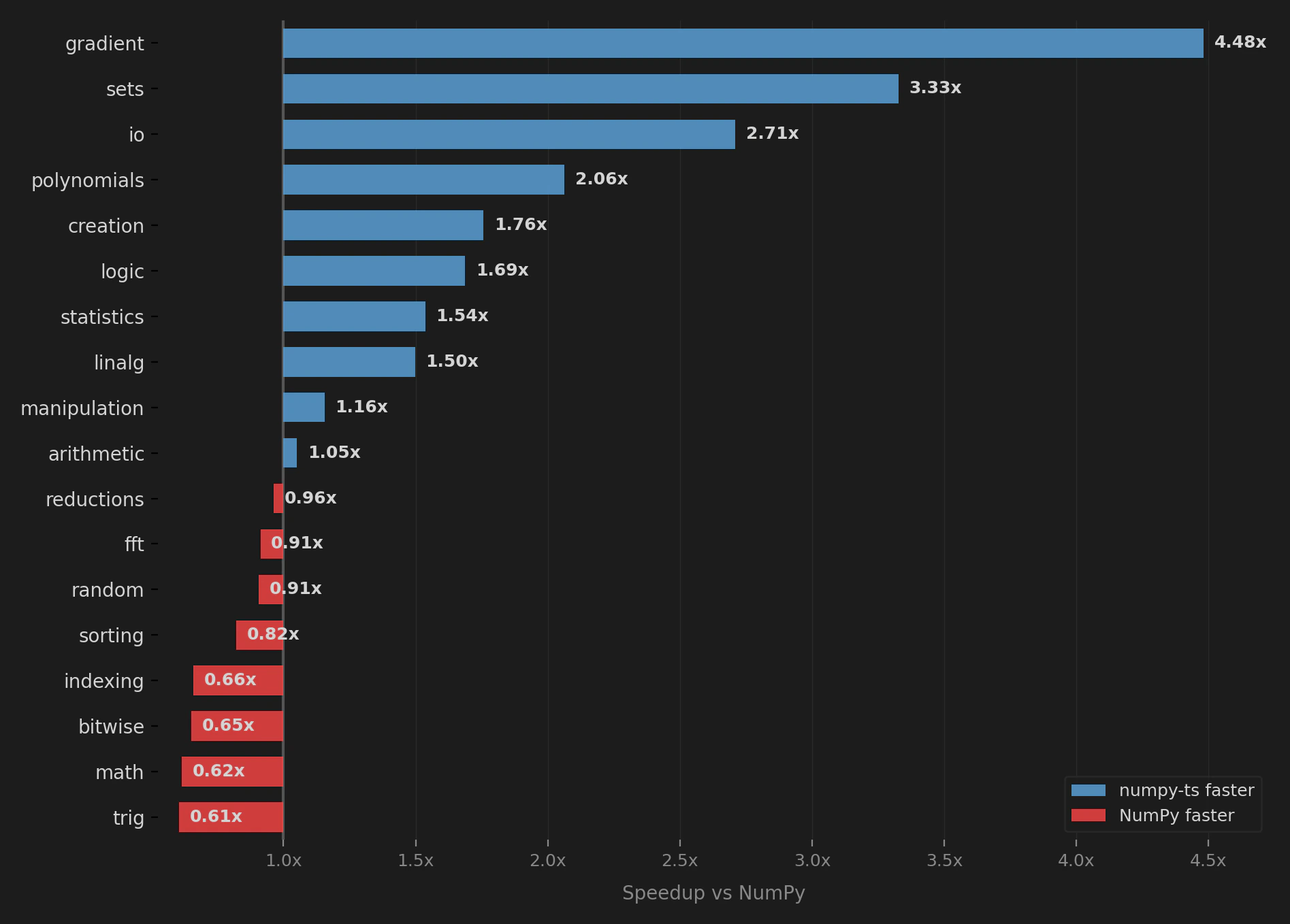 See the full breakdown of category results on the [numpy-ts vs. NumPy page](./vs-numpy).
## Performance by Data Type
Smaller data types see the biggest gains — numpy-ts's SIMD kernels process more elements per instruction for `int8`, `uint8`, and `float16`. Even `float64` (NumPy's home turf) is on par.
See the full breakdown of category results on the [numpy-ts vs. NumPy page](./vs-numpy).
## Performance by Data Type
Smaller data types see the biggest gains — numpy-ts's SIMD kernels process more elements per instruction for `int8`, `uint8`, and `float16`. Even `float64` (NumPy's home turf) is on par.
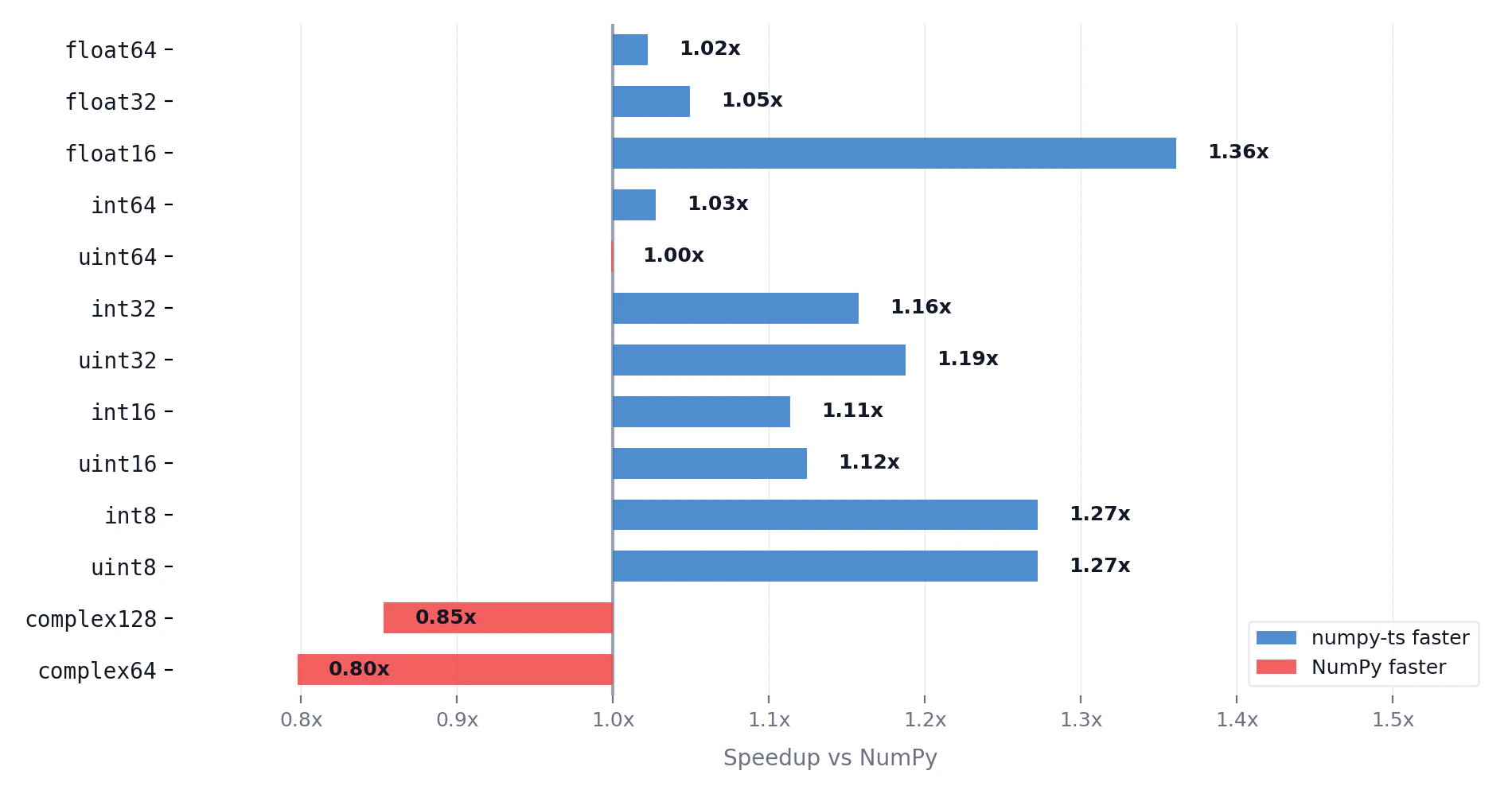
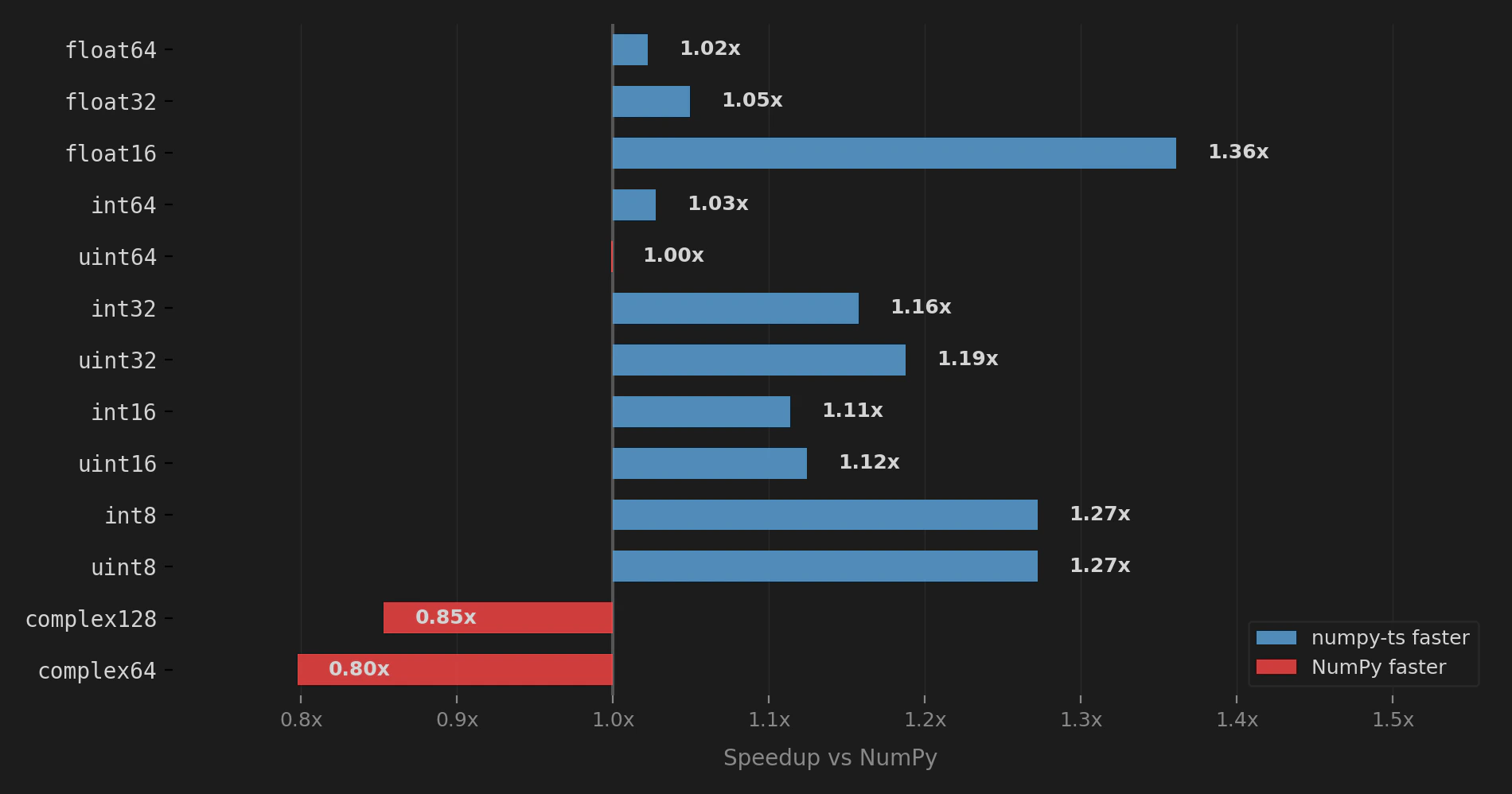 See the full breakdown of dtype results on the [numpy-ts vs. NumPy page](./vs-numpy).
## Performance by Array Size
numpy-ts is as fast or faster than NumPy at every tested array scale — from small (100-element) arrays where low overhead matters, to large (10K-element) arrays where SIMD throughput dominates.
See the full breakdown of dtype results on the [numpy-ts vs. NumPy page](./vs-numpy).
## Performance by Array Size
numpy-ts is as fast or faster than NumPy at every tested array scale — from small (100-element) arrays where low overhead matters, to large (10K-element) arrays where SIMD throughput dominates.
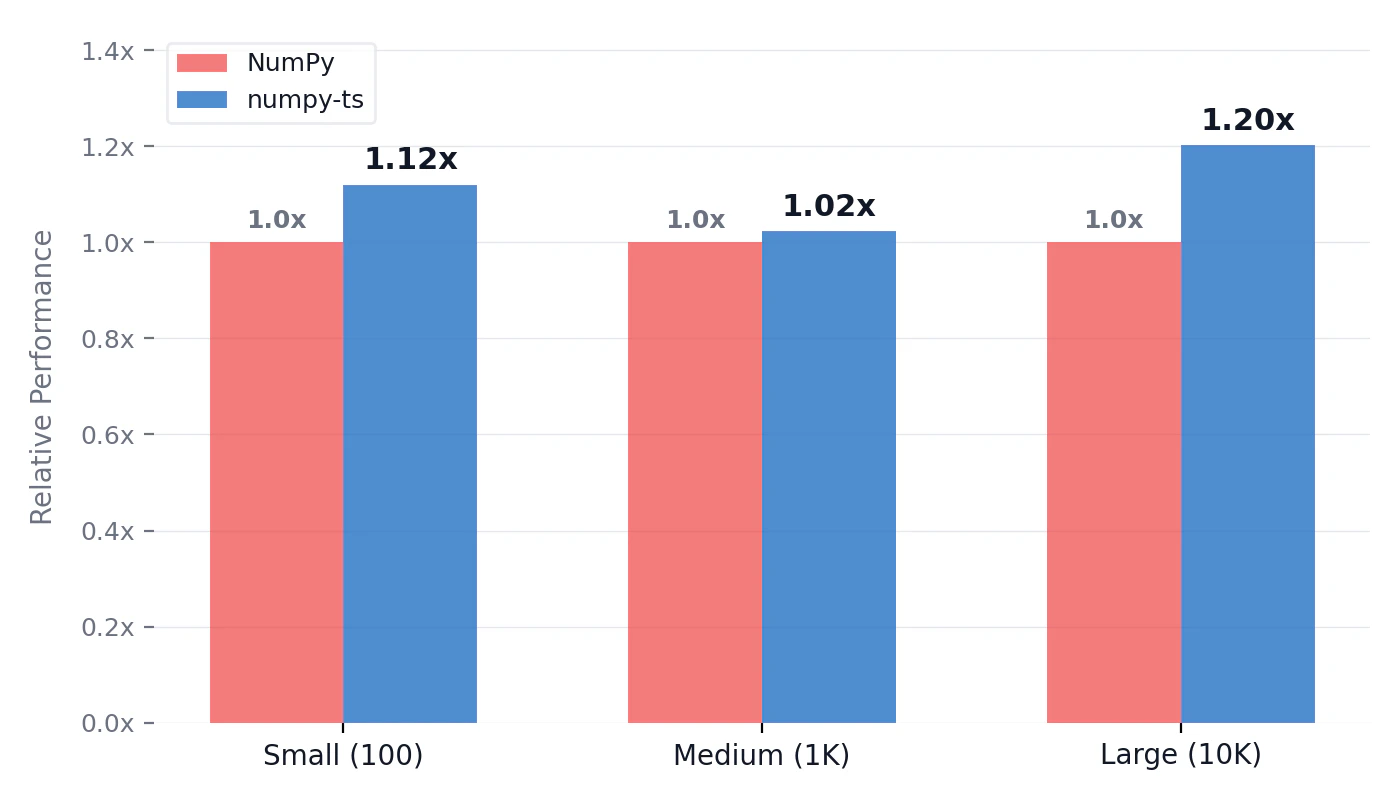
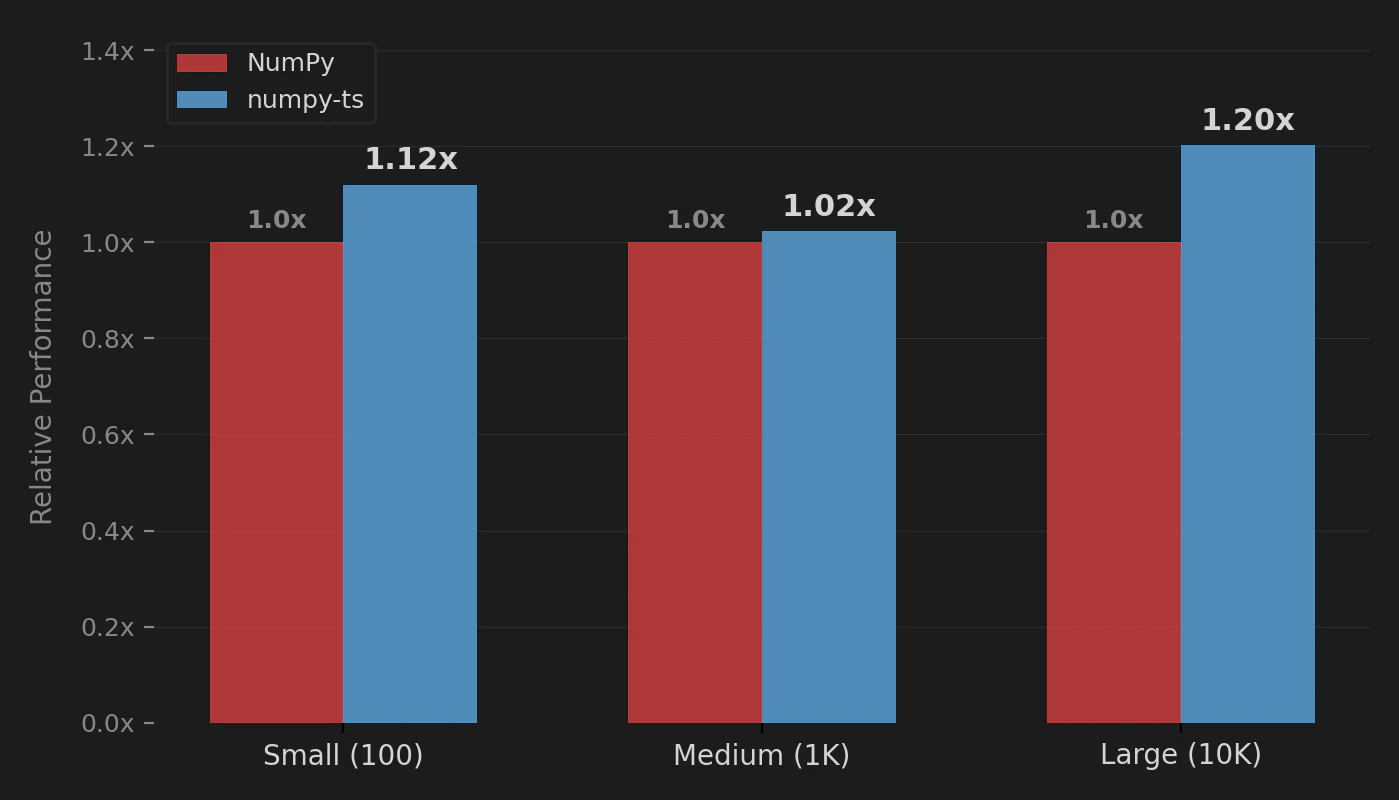 See the full breakdown of array size results on the [size scaling page](./size-scaling).
## All Benchmarks
How does numpy-ts compare to NumPy running natively in Python with OpenBLAS?
How does numpy-ts compare to NumPy running in WebAssembly via Pyodide?
How does numpy-ts performance scale across small, medium, and large array sizes?
How does numpy-ts perform across different JavaScript runtimes?
See the full breakdown of array size results on the [size scaling page](./size-scaling).
## All Benchmarks
How does numpy-ts compare to NumPy running natively in Python with OpenBLAS?
How does numpy-ts compare to NumPy running in WebAssembly via Pyodide?
How does numpy-ts performance scale across small, medium, and large array sizes?
How does numpy-ts perform across different JavaScript runtimes?